Workplace wellness challenge
A wellness challenge every team can win.
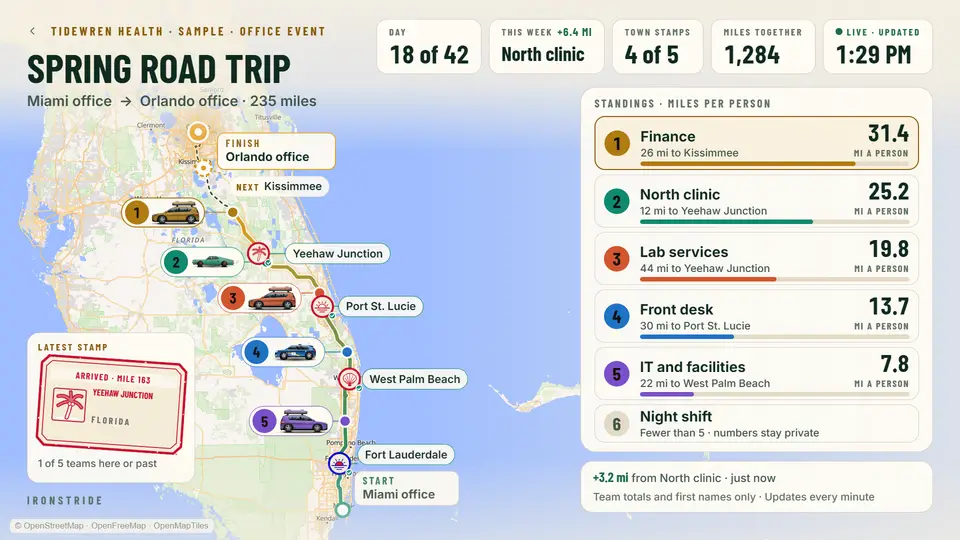
Team Road Trip races your departments between two real places on the map. Teams are ranked by miles per person, every sport counts, and the live board goes on the office TV.
Free for up to 15 people · Members always join free
Why challenges fade
Step contests fade. This one doesn’t.
How it works
Live in four steps.
Pick a road
A famous American road, or the road between your two offices.
Make teams, or not
Departments, sites or shifts, or everyone on one board.
Share the code
Send the announcement or print the poster. People join free.
Watch it move
Put the live board on any screen, then roll into the finish.
For wellness leads
Built for the person running the program.
A corporate wellness challenge lives or dies on week three. Team Road Trip gives people a reason to come back: the next town on the road, a weekly winner, and a board on the break-room TV that shows their team moving. You get admin tools and a Monday email with where things stand.
Run one road trip for up to 8 weeks, or run them all year on the yearly plan. Planning a company 5K at the end? Race day is included with your road trip, with online sign-up, check-in and results. Remote or hybrid team? Every mile anyone moves, anywhere, counts for their team.
At the finish, you get team totals as a spreadsheet file and a finish postcard to share. Typed-in workouts follow the rules you set, so the race stays fair.
Tidewren Health · week 3 of 6
Spring Road Trip
Trust
Privacy people can say yes to.
Routes stay private
Boards show first names and miles, never where anyone went.
No ad networks
No tracking across apps, and your people’s data is never sold.
A real app, not a portal
Members get the whole Ironstride app free, and keep it after your challenge ends.
What it costs
Public prices. No quote to see one.
Free for up to 15 people. One road trip is $5 a member for up to 8 weeks ($99 minimum). The yearly plan is about $1 a member a month: $12 a member a year for the first 500, less after that ($299 a year minimum). Members never pay.
Questions
Workplace wellness challenge questions.
What is a workplace wellness challenge?
A friendly competition that gets coworkers moving for a set time, usually a few weeks. In Team Road Trip, teams race between two real places, and every workout moves their team down the road.
Do employees pay anything?
No. Members always join free, and they get the whole Ironstride app. The organization pays by the number of members, and up to 15 people is free.
What if someone doesn’t run?
They walk, hike, bike, row or swim. Walking counts mile for mile, and teams are ranked by miles per person, so nobody has to be fast. Strength and yoga days count toward each person’s daily goal, not road miles.
Does it work for remote and hybrid teams?
Yes. Every workout anyone records, anywhere, counts for their team. The live board is a link, so it works on any screen.
How long should a workplace challenge run?
Four to eight weeks is long enough to build a habit and short enough to keep the energy up. One road trip runs up to 8 weeks, and the yearly plan lets you run one each season.
What can organizers see?
First names and miles on the shared board. Organizers never see anyone’s routes or where they live.
Keep exploring